Well, I took part in my second RIPFEST where we create something from nothing extremely rapidly with people you've just met. It's an exhilirating experience and highly recommended. Check out the RAW IMPRESSIONS
website for more info.
After they've gathered 5 teams worth of film crews including directors, producers, actors, dps, editors and composers, we're given some rules, locations, permits and a structure to focus on just creating a new short film in 16 days with a screening at the Anthology Film Archives in New York City at the end.
Our theme? Second Chances.
Tuesday, December 05, 2006
Making a film in 16 days with complete strangers


Monday, October 23, 2006
Anti Mind Pollution Media Cloud

I was interviewed in a recent issue of the Toledo Blade regarding my role as Executive Music Producer on a new 24 minute Christian film, Transgression.
“What I liked about this script was that it didn’t offer an easy, pre-digested answer. There is room for expansion and discussion,” Mr. Ingkavet told The Blade.
Transgression had “a thoughtful script with a powerful message of mindfulness. Being a spiritual person, I am naturally attracted to projects that are not just adding to the mind-pollution media cloud,” he said.
See full article
Abandon at LaMama - dreaming with ears wide open

We just finished our first weekend of Abandon at LaMama and wow...it's like dreaming lucidly and vividly and intensely for 70 minutes. Yes I did write the music, and still, sitting through a performance is like something else. I am so proud and grateful to all involved.
As I explained to my father last night, you can approach this like an abstract painting. There is a storyline, though everyone will experience it differently.
Friday, October 13, 2006
Writing 75 minutes of music score

Many of you know that I've been working like mad to finish a 75 minute score for theatrical production called Abandon opening next week at LaMama ETC. The piece is very multi-sensorial and was birthed from a collection of about 75 visual collages made by the writer/director/artist Matthew Maguire. Maguire is also the current head of the theater program at Fordham University at Lincoln Center here in New York and started his career in a very abstract style similar to Ping Chong, and Meredith Monk among others at La MaMa ETC. 6 actors interact with these living collages brought to life in video by Zbigniew Bzymek on 3 screens which form the back walls of the stage. And throughout is my music. It's very dark, abstract, erotic and incorporating elements of butoh and modern dance and yet still tells the story of Helena, a woman with an intense fear of love and it's consequences.

The process has been quite intense and exhausting and I'll share some behind the scenes process in the next few days. I need to still finish the score. Here's a sneak preview of a music cue

To purchase tickets click here
Wednesday, October 04, 2006
Filmmakers Festival - Edit Ves presentation slides

I've posted the slides to my presentation here:
I talk about the uses of music to picture, what it can achieve (and not) and how to communicate between Visual and Aural creatives while using examples from my work in feature films, commercials, animations and shorts. The clips can be found elsewhere on the site.
Monday, October 02, 2006
Tidelands and Germany

It has been a very full life lately. Just came back from a week in Germany 4 days in Frankfurt and 3 in Berlin. A great trip and got to meet some lovely folks including Terry Gilliam who was honored at the filmmaker's festival where I too was presenting. We got to see Terry's latest, "Tidelands" which, as a parent, I found very hard to watch. Jeff Bridges is pretty great as a junky father. The little girl, Jodelle Ferland as Jeliza-Rose is great. It really is like Alice in Wonderland meets Psycho.
 Working hard on the score to "Abandon" which is opening on October 19 at LaMama ETC downtown New York City- (lower east side) The show must go on.
Tuesday, August 29, 2006
How we perceive film: Hear/See

A friend asked me to comment on a proposed curriculum for film school students regarding Post-Production audio. This made me refer to some old Walter Murch articles which still astonish me as to how accurately he describes the film sound experience. (Murch is the original holder of the title sound designer and has won several Academy Awards for sound editing, film editing and sound design.)
"This reassociation of image and sound is the fundamental pillar upon which the creative use of sound rests, and without which it would collapse...
film seems to be "all there" (it isn't, but it seems to be), and thus the responsibility of filmmakers is to find ways within that completeness to refrain from achieving it. To that end, the metaphoric use of sound is one of the most fruitful, flexible and inexpensive means: by choosing carefully what to eliminate, and then adding back sounds that seem at first hearing to be somewhat at odds with the accompanying image, the filmmaker can open up a perceptual vacuum into which the mind of the audience must inevitably rush...
The rumbling and piercing metallic scream just before Michael Corleone kills Solozzo and McCluskey in a restaurant in "The Godfather" is not linked directly to anything seen on screen, and so the audience is made to wonder at least momentarily, if perhaps only subconsciously, "What is this?" The screech is from an elevated train rounding a sharp turn, so it is presumably coming from somewhere in the neighborhood (the scene takes place in the Bronx).
But precisely because it is so detached from the image, the metallic scream works as a clue to the state of Michael's mind at the moment — the critical moment before he commits his first murder and his life turns an irrevocable corner. It is all the more effective because Michael's face appears so calm and the sound is played so abnormally loud. This broadening tension between what we see and what we hear is brought to an abrupt end with the pistol shots that kill Solozzo and McCluskey: the distance between what we see and what we hear is suddenly collapsed at the moment that Michael's destiny is fixed."

This "sound-stretching" is the same thing composers do when working on a film. By stretching the distance between what is portrayed on screen and what is heard... the mind of the viewer perceives a vacuum into which they pour their own associations and emotion. The music is the sub-text to the screen action.
Thursday, August 10, 2006
Being There
A wonderful painting is the result of the feeling in your fingers. If you have the feeling of the thickness of the ink in your brush, the painting is already there before you paint. When you dip your brush into the ink you already know the result of your drawing, or else you cannot paint. So before you do something, "being" is there, the result is there. Even though you look as if you were sitting quietly, all your activity, past and present, is included, and the result of your sitting is also already there. - D.T. Suzuki
These words are as true for music as any art.
These words are as true for music as any art.
Wednesday, August 09, 2006
Who Needs A Composer Anymore - I'll Just Cinescore it.

Filmmakers today have unprecedented control over what goes into the their films. With HD cameras now costing less than $1000 (Sanyo's HD1) and MacBooks with FinalCutPro or even iMovie - you can create films with a total kit costing less than $3000!!
With the hands-on, DIY ethic that has emerged, everything that used to be complicated and difficult about filmmaking is now enormously easier. This has also happened with music with Apple's GarageBand, Sony's ACID and a ton of music making software that enables the slightly talented to sound genius, or almost.
So what about scoring your film? As an indie filmmaker, you probably were your own Rebel without a Crew staffing the DP, Art Director, Gaffer, Director, Casting and Editor positions of your film. Maybe even Caterer and Location Scout and Morale Support. Why not just write your own music too using these easy to use cheap tools?
And, with the emergence of new software like Sony's Cinescore, who needs a Composer nowadays anyway? Aren't they just like last century's Coopers? Who needs a barrel-maker anymore?
Well, yes, you as a filmmaker can do everything yourself.
Robert Rodriguez actually tries to do it all himself even with big budget Hollywood and the unions...for which I think his films suffer. The beauty of film is a team effort and the exponential magic that happens when great minds contribute to a whole. But that's for another post.
Now of course, you're thinking, cut the crap, I've got $5 to make this picture - who needs a Composer?
And here's my argument. Music is a direct line to the heart. It is the "feel" of the movie. People slink down in their seats when the horrific music signals to them that they should. If you have the abilities to create that in addition to creating your film, then go ahead. It is doable. But to do it well is another thing. Try Cinescoring a soundtrack as indelible, evocative and as proprietarily mnemonic as John WIlliams' Jaws.
And why suffer when for 5 to 10% of your production budget, you can have a dedicated, raving, film-loving music-making pro actually doing this with you?
Now the only hard part is communicating exactly what it is you want/need/desire. We'll tackle this in a later post. And if you don't know what you want (not unusual), no one in the world does. (please never say "I'll know it when I hear it.")
Here's an interesting perspective on Sony Cinescore from Mark Northam, founder of Film Music Institute.
Saturday, July 29, 2006
Woody Allen on the 2 types of Film

Woody Allen interviewed on PRI's Studio 360 with Kurt Anderson:
"Sometimes I think to myself that there are 2 types of films. There's the confrontational film that deals with life issues and existential issues and political issues. And there's the kind of film that is escapist. And I always debate with myself – which one makes the better contribution? You would think off the top of your head that the confrontational films are superior to the escapist films. But the truth of the matter is, the real philosophical issues of life, you know religious issues, issues of mortality and issues of human suffering are never resolved in any of these movies. Because you can't resovle them. So people just go and they commiserate masochistically and they come out of the theater moved in some way. Where with an escapist film, at least you give the audience a chance to get away from the horrors of reality for an hour and a half. It's like going into air conditioning or something and just sitting down and watching Fred Astaire dance for an hour and a half. You come out at least refreshed. And then you can go on with your life a little bit. And so I'm not sure that escapist films and comic films are not more of a help in the long run. Even though the temptation is to always to think and to want to do more substantive things."
Wednesday, July 26, 2006
Trust your Creative Team
This is a great post about advertising creative which applies equally well to this world of filmmaking.
When you hire your team - trust them to do the job you've hired them to do regardless of whether they are a DP, or an Editor, a Production Designer or a Composer. 1+1+1 really does equal 58,000,000!
snippet:
BART CLEVELAND: A creative team walks into the conference room with freshly mounted layouts underarm. They have worked untold hours to develop the ideas they now carefully share with others. Every detail has been examined and re-examined. There has been nothing left to chance. The work is superb. Their audience applauds with appreciation and admiration.
Then there is the “pause to reflect.”
A glimmer appears in one observer’s eye. Similar to telling a painter where he has missed a spot, the observer helps make a good idea better by adding that perfect little addition that causes good to become great. Then another glimmer appears in another observer’s eye. Well, I can’t go on because it’s just too gruesome.
When you hire your team - trust them to do the job you've hired them to do regardless of whether they are a DP, or an Editor, a Production Designer or a Composer. 1+1+1 really does equal 58,000,000!
snippet:
BART CLEVELAND: A creative team walks into the conference room with freshly mounted layouts underarm. They have worked untold hours to develop the ideas they now carefully share with others. Every detail has been examined and re-examined. There has been nothing left to chance. The work is superb. Their audience applauds with appreciation and admiration.
Then there is the “pause to reflect.”
A glimmer appears in one observer’s eye. Similar to telling a painter where he has missed a spot, the observer helps make a good idea better by adding that perfect little addition that causes good to become great. Then another glimmer appears in another observer’s eye. Well, I can’t go on because it’s just too gruesome.
Monday, July 24, 2006
Your True Voice

Every artist spends a lifetime searching, discovering, refining and rediscovering their "voice." Whether a painter, a novelist, a dancer, a singer or a composer. The artist, regardless of medium, expresses themselves in a certain way that after a few experiences of this artist's work, is readily recognizable. It's the artist's "filter" on the way they perceive. Things come through them and are twisted and shaped and come out as a "Picasso", a "Faulkner" or a "Beethoven."
Recently, I took part in a great film scoring workshop. A bunch of us have put our work online so you can really see how no Composer approaches the same scene the same way. Take a look/listen.
Friday, July 14, 2006

Thursday, July 13, 2006
Edit Ves Filmmaker's Festival, Frankfurt Germany

Just got the exciting news that I will be a featured presenter at the 9th annual Edit Ves Filmmaker's Festival in Frankfurt, Germany on September 25, 2006. The festival is unlike others in that it delves deep into the heart of process, approaches, theory on the art of visual storytelling and attracts professionals in the areas of film, television, commercials, gaming, new media and more.
I will be speaking and showing examples of our process at 300 Monks especially with regards as how we bridge the gap in communicating about emotions from visual to audio.
Previous festivals have included talented filmmakers such as Roland Emmerich, Michael Ballhaus, Dante Ferretti, Dennis Muren, Vilmos Zsigmond, Phil Tippett, Peter Greenaway, Marco Müller, Tom Rolf, Bill Plympton, Emir Kusturica and many more incredibly skilled storytellers.
The festival runs from the 24th to 26th of September. You can learn more here.
Sunday, July 09, 2006
A Filmmaker's Audio Team

Don't let these guys do your film sound!
There seems to be not a lot of information given filmmakers in school or even in books regarding who can help with the audio side of film.
Before we do this there needs to be distinction between location audio and post- audio. These are very different jobs and usually different people as the equipment, disposition and skills are completley different. Location audio guys will have a mobile recording setup (either 2 track or multi-track) which nowadays can be on miniDisc, tape, CD, DAT, DVD, Hard Drive or a swappable media such as CompactFlash, SmartDisk, MemorySticks or something similar. Some of these units can hook into the camera or a digital slate for true professional recording with reference points for the later tedious and laborious process of logging all the footage and audio and syncing it. Location audio specialists will also have a number of special mikes including shotguns, lavalier (hopefully wireless) and boom poles and windscreens. This stuff is not cheap. The blimp windscreens alone are around $500! An industry standard Sennheiser shotgun mic is over $1000. And then headphones and perhaps a mobile battery-powered mixer for multi-mic recordings.
For post-production audio, your team can include one or all of the following:
- Music Supervisor - person with a vast encyclopedic knowledge of music who can suggest/find songs for use in film and then arrange the licensing agreements for those songs. The licensing part may actually be more work than the actual creative part especially with well known songs. Can also be the person to hire the Composer.
- Music Editor - person who edits the music to conform with the picture. may also add a temp score to the rough cut for use by the Composer.
- Composer - person who will write the music for the film. This person, depending on the deal, may also be responsible for contracting the musicians, conducting and recording the score. The greatest Composers can lift up, unite and emotional bind a story as music speaks quickest to the heart, leading the eye.
- Music Producer - a vague term in film, this person can be in charge of the music for the production. Can also be another name for the Music Supervisor or the person who brings all music elements into the production. For example, T. Bone Burnett was the Music Producer for the film "Walk The Line." His job included finding the songs they would sing, teaching Reese Witherspoon and Joaquin Phoenix to sing believably, arranging the songs, contracting the musicians and booking a studio and supervising the production of the final recordings.
- Sound Designer - These people are unique in their ability to create and recreate sounds that create hyper-realism on screen. They often will mix in unexpected sounds to beef up the results. For example, in "Fight Club" the sounds of the punches were layers and layers of sounds of meat being punched, kicked and beat. It was so powerful, the director David Fincher asked for a version without the extra violent sounds to pass the review board for an R rating instead of an NC-17.
- Mix Engineer - This person is the one to bring all the final audio elements together into a cohesive experience. These disparate elements can be dialog, sound effects, music in final mixes, or music in stems, voiceovers and source sounds. They can do separate mixes for cinema, television, web, promos, and these can be in a combination of stereo or surround sound.
Wednesday, June 14, 2006
One Second Radio Ads - Audio Branding In A Blink
From AdAge:
BACKGROUND: Clear Channel, the country's largest operator of radio stations, is discussing the idea of one-second radio spots with marketers and media buyers. Called "Blinks," the new format is being promoted as something that could be used between music tracks by, say, McDonald's to play part of its "I'm lovin' it" jingle or Intel to play its chime or NBC for its bells between music tracks. Clear Channel VP-Creative Jim Cook says the one-second format is part of an effort "to find new uses of radio for advertisers who are continually asking us to demonstrate that our medium can successfully extend brands, can successfully reach the consumer with touchpoints that are new and surprising." Critics suggest the format is likely to fit a very small number of advertisers and is too restrictive for meaningful creative. What do you think?
I think it's a natural evolution. Everything has been moving to smaller, faster, cheaper, better. The human mind/ear can discern and recognize melodic fragments, textures, harmonies in a millisecond. And as the article suggest, it's probably best suited for marketers who have already had media exposure to their audio mnemonics such as NBC or Intel or McDonalds.
I'd love to work on one of these if anyone wants to try it out. I've done some short audio mnenonics for HP in the past that were never sold through. Anyone?
BACKGROUND: Clear Channel, the country's largest operator of radio stations, is discussing the idea of one-second radio spots with marketers and media buyers. Called "Blinks," the new format is being promoted as something that could be used between music tracks by, say, McDonald's to play part of its "I'm lovin' it" jingle or Intel to play its chime or NBC for its bells between music tracks. Clear Channel VP-Creative Jim Cook says the one-second format is part of an effort "to find new uses of radio for advertisers who are continually asking us to demonstrate that our medium can successfully extend brands, can successfully reach the consumer with touchpoints that are new and surprising." Critics suggest the format is likely to fit a very small number of advertisers and is too restrictive for meaningful creative. What do you think?
I think it's a natural evolution. Everything has been moving to smaller, faster, cheaper, better. The human mind/ear can discern and recognize melodic fragments, textures, harmonies in a millisecond. And as the article suggest, it's probably best suited for marketers who have already had media exposure to their audio mnemonics such as NBC or Intel or McDonalds.
I'd love to work on one of these if anyone wants to try it out. I've done some short audio mnenonics for HP in the past that were never sold through. Anyone?
Tuesday, June 06, 2006
Keeping Your Film's Action Moving With Music

A great thing to keep in mind whether you are using a song or score with your film scene is to be mindful of closing cadences. A cadence is a musical term to describe an ending point. In classical era music you often hear a series of chords that set up the final resounding last chord. Pop songs also usually have clearly defined endings or fadeouts which signify the end.
If you want to keep propelling the dramatic action forward, edit your music so that it never ends on a finality. It stops the dramatic action and subconsciously closes the curtain. This may be useful for the end of Act 1 in your screenplay, and yet it also may stop the action too early.
Martin Scorsese is currently working on a film called "The Departed", (a remake of a 2002 Hong Kong film entitled Infernal Affairs) and Howard Shore is scoring. According to Tim Starnes (one of Shore's right hand men) Scorsese is very much attuned to the "curtain calls" in the music. Whether it's song or score, he often edits the piece to start after the beginning and end in the middle.
If you are working with a Composer, you can bring this up in conversation early in the process.
One way Composers can avoid the "dramatic finality" is to avoid the use of the tonic (the root note) in the bass. As orchestrator Deniz Hughes likes to say, "putting the tonic in the bass is the dramatic equivalent of sitting in a chair. You're not going anywhere. You're static."
Monday, June 05, 2006
Audio Branding the AARP

Today's New York Times has a great article on audio branding with the AARP as the client.
Thursday, June 01, 2006
Bourne Again

So the culmination of my 2 weeks at the ASCAP/NYU Film Scoring Workshop in memory of Buddy Baker was to rescore the final scene from the Bourne Identity.
We spent a day sketching, another to orchestrate and then checked it by conducting a piano reduction with a rehearsal pianist
(conducting the pianist)

and then the big day with an outstanding 23 piece orchestra. 3 takes and there we were.
Here's the clip without any music.
Here it is with my take on the score.
(A portion of an early sketch - it changed continuously until 3am the night before the recording!)

And I don't remember what the original by John Powell sounded like. What was really interesting was seeing other Composers versions of the same scene (we had a choice of 4 scenes.) No one sounded alike and everyone had their own voice/thumbprint.
A great exercise and highly recommended for Composers and anyone interested in Film Music. You can audit the program as well which may be useful for Producers/Directors wanting to know how the whole process works - and having a pick of 18 amazing composers to work with in the same room!
Wednesday, May 31, 2006
Creating Something From Nothing

Just spent an exhilirating, exhausting and truly inspiring 2 weeks in the Buddy Baker Film Scoring Workshop co-sponsored by NYU and ASCAP. In it's sixth year and now in memoriam to Buddy as he passed away a few summers ago.
Buddy was one of the long-time Disney composers (something like 28 years!). Those studio golden days seem to be over - especially in terms of music departments. Even Pixar, the closest thing to the studio setup that Walt had, doesn't have composers on staff.
In the old days of Disney, animators and composers would talk and meet periodically and then work parallel paths. Animators had a time sheet and script/storyboard which they would work from and composers would take that information and create their cues. The picture and music would get married up only towards the very end. It really is creating something from nothing. Yes there is a story and that's what holds the two together. Too often in today's pressurized, commercialized productions the picture is given all the attention and the music is literally slapped on at the end. Now I have no doubt that great music supervisors can find music that fits your picture and adds something you never could have imagined. On the other hand, films like Lord of the Rings or Star Wars...I can't imagine them having such long-lasting influence and impact with a licensed score. Yes there are times you NEED a song from the popular culture zeitgeist. Scorsese does it all the time. And now he also uses Howard Shore for scoring those other scenes that need underscore. Or you can hire someone to write songs specific to the film - this seems to be out of fashion nowadays.
I call it the Rise of the Editor culture.
When hiphop started to take the film editors approach to assemblage using "found footage", filmmakers also started to take the same approach towards their music soundtracks. And with anyone who grew up in the age of MTV, fast cuts and cutting to music is the norm.
I'll share more of the workshop in the next few days.
Sunday, May 28, 2006

Tuesday, May 16, 2006
Film Composing: Where is the Love?
 For many first time directors, there is a huge underestimation of the amount of work involved on the part of Composers and I suspect Editors. Though editors usually are sitting with the director for perhaps weeks or months at a time, Composers are given a brief conversation and then left to their own devices for the most part. 4 to 6 to 8 weeks later the score is delivered and if there is not massively clear, constant and open communication between the two, disasters can happen. With so much of the subtext being communicated via music score (depending on the film) it's astonishing more thought/training is given this area.
At the recent Sundance at BAM brunch, I was impressed by the amount of support the Institute provides from the ground up and in so many more areas than I knew: film, theater, film music, screenwriter's labs, directors labs. And the cross-communication between the different labs sounds impressive as well. I know I'd like to go - I'll have to wait until next year as the deadline is April 1. It's interesting to note the Sundance Film Festival does NOT have a category for Best Music Score.
On the other hand, IFP, the huge NY-based indie filmmakers network aims to support filmmakers similarly. The results are a bit less impressive, especially as regards film music. At a recent IFP Market panel on film music, the majority of the conversation was on licensing tracks from your favorite band. There was so little advice on where directors can meet composers. It's as if they all were saying you can find a great indie band that has a film composer in it.
And then, there's the Independent Spirit Awards - where's the category for best music score?
Thursday, May 11, 2006
Short Film - K7

This is another short that really got my attention at Tribeca. It has that great Kafka-esque quality of not knowing why and how things are happening at the same time being hysterically funny. It's also amazing as you realize how entertaining it can be with little more than an office as a shoot location. Great writing and wonderful performances. Directed by Christopher Leone.
Inspiring.
Here's a clip.
Wednesday, May 10, 2006
Short Film - Lure

Saw this great short at the Tribeca Film Festival by Writer/Director Mark Mollenkamp. Very cool and current, Lure has a pretty great surprise ending. In speaking to the director at the bar, he mentioned that he got a meeting with the Weinstein Company out of this. Not bad for an 11 minute short.
You can see a preview.
Friday, May 05, 2006
The Groomsmen

Saw the Groomsmen the other day at Tribeca Film Fest. It's the latest film by writer/director/actor Edward Burns. While I always found Edward Burns' characters to be repulsively smug, I must say I enjoyed this film. Very well written and performances from John Leguizamo (viva Colombia!) and Jay Mohr (who almost steals the show). The inciting incident is the upcoming wedding of the Burns character to his pregnant girlfriend and the week hanging out with his groomsmen before the big day. They're all kids at 35 and trying to grow up.
The setting is in Long Island - which is where I grew up. It really hits it on the nose - I was cringing with the puffy hairdos, the "strong island" references, the horrible 80's rock songs and the accent (Ya wanna get sumthin ta eet?). I should have hated this film - but it's a great story and well done.
I'll pass on the soundtrack though. What was it with the 80's?
Thursday, May 04, 2006
What would Jesus Direct?

That was the panel I saw the other day at the Tribeca Film Festival. Due to the recent success of Mel Gibson's Passion of the Christ, everyone's looking for the next religious hit.
With Cuba Gooding Jr., Jonathan Bock(Grace Hill), Ralph Winter(20th century Fox, Michael Flaherty (co-founder Walden Media and moderated by a woman from PBS, the panel talked about the sudden realization by Hollywood of the Christian market. Flaherty mentioned that a recent survey had 40% of Americans in church on Sunday - duh! What a huge mega market. Walden Media had a huge hit with Chronicles of Narnia which as one audience member said "I'm Jewish and I read that book as a kid and loved it. I didn't think about is this a Christian book or not - it's a great story."
And as the panel went on - the basic overall message is: is it a good story? Will it captivate people no matter what their faith?
Poor Marty Scorsese with his Last Temptation of Christ which brings up many of the same issues that the coming DaVinci Code does. Too early? Well actually most people found the film too boring.
I still love the soundtrack by Peter Gabriel - it's even better than the film.
And in related news...the film I scored last year Mrs. Worthington's Party is now garnering some interest at a certain major studio. As it deals with priests and the Catholic Church and Christmas, we hope to see it on the big screens just as the first snow falls. I may be in Bulgaria in the next few months recording new bits of score. Stay tuned.
Thursday, April 27, 2006
Secrets of the Code

The 5th annual Tribeca Film Fest is in full swing. It's my first time going and it's nice to see how intimate it is.
Saw an interesting preview of a work in progress last night called Secrets of the Code based on a book of the same title. It's another of the many projects that have been spawned by Dan Brown's mega blockbuster book "The Da Vinci Code". There's an entire industry built out of that book with other books debunking or debating issues brought up in it, documentaries (at least 10 out there) and even travel tours to Paris and places visited in the book.
And...on May 19th, the Hollywood film version by Ron Howard and starring Tom Hanks is unleashed to something like 50 countries simulataneously. Many predict it will be the biggest grossing film of all time. And Hans Zimmer is Herr Maestro.
Tuesday, April 25, 2006
The Spy Genre of Music - All things Secret Agent

It's been a long time since I last posted. Sorry for the break - just needed to take care of a hundred things including a score for a short animated film for Pfizer's Listerine brand. Yes - it's a mini DVD that's going to be included on a millions of product packages for Agent Cool Blue. With a name like that, of course it's going to be an animated character super-hero.
And I got to play in a great area of music - the 50/60's tv spy theme genre. Peter Gunn, Get Smart, Pink Panther, James Bond, Secret Agent Man, Batman, the Man with the Golden Arm and all those great jazzy classics. And after carefully researching my references - which I do on every project - it was revealed to me the secret black knowledge of the 1950's/60's movie/television composer.
There's a very specific scale that everyone in this genre used. It's like each theme is an inversion of the other. Anyway, you can hear a sneak peek at my theme here.
Kapow! Blam! Zowie! Zoinks!
Wednesday, March 22, 2006
Grifters, Drifters and Hustlers
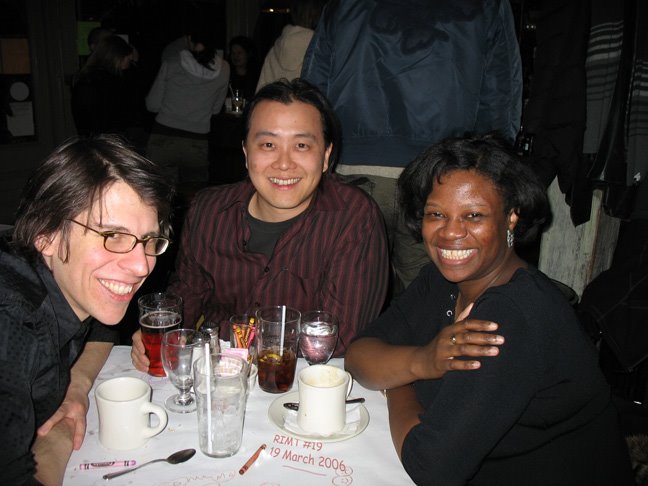
Here at the Ear Inn after show for a much needed drink. (L-R: Writer Sammy Buck, Composer Andrew Ingkavet, Writer Cheryl Davis - some of the participating artists in RIMT19 - photo by Composer Dan Acquisto -hear his work in the upcoming RIMT21 )
We survived and even prospered - the 19th Raw Impressions Music Theater event has ended. But wait there's more this weekend and next with whole new teams of composers, writers, performers and directors creating new 10 minute musicals.
As I said in my previous post, I find the act of creating fast and furious to be exhilirating, freeing and inspiring. Highly recommend it as a creator and an audience member.
Oh, and our theme was Grifters, Drifters and Hustlers - not that these fine folks are in anyway...not to besmirch their characters.
Thursday, March 16, 2006
Creating Fast and Furiously

This past Friday I went to a meeting with about 40-50 people – actors, directors,writers, composers, producers – and after hearing the actors sing a song each, we were split into teams, given a theme and told
"Go write a 10 minute musical. And it will be produced and performed the following weekend.
Oh and you have 48 hours for a first draft."
Well my team's show is going pretty amazingly well (there are 8 teams) and you're all invited to it this coming Sunday and Monday evening 7 and 9pm in New York City.
Check Raw Impressions for info/tickets. It will sell out. I'm in the event RIMT#19-Guitar-based music theater - "Grifters, Drifters and Hustlers."
And there's something about creating as quickly as possible. A teacher/mentor of mine says "Write Like Mad!" And I was like, why? It's only an exercise. "Well, you'll one day be in the situation where you have a string quartet to write/orchestrate in 24 hours. Get in the habit of writing as quickly as possible."
It's good advice. Most commercial jobs I've worked on in the last 5 years have been,
"We need it yesterday! Can you give us a broadcast-quality produced demo by the end of the day? And if we like it, you'll have time for revisions." (perhaps another 24 hours.)
There's a lot of talk about quick decision-making lately. The Boston Globe ran an interesting article summarizing the whole state of this recently Malcolm Gladwell (famous for "The Tipping Point") has a current best-seller "Blink" about how we make decisions in the blink of an eye and then spend hours, days, weeks and even months rationalizing, justifying to our conscious-left brain why it's the right decision.
I find that when you shut down the editor in your brain and just create as quickly as possible, you reach for intuitive, instinctual choices that really are at the core of your "true voice."
As the great teacher of composition, Nadia Boulanger once said, "Never ignore the obvious." and “Everything we know by heart enriches us and helps us find ourselves. If it should get in the way of finding ourselves, it is because we have no personality.”
Word!
Thursday, March 09, 2006
Jazz-based Film Scores

Otto Preminger's 1955 film, The Man With the Golden Arm is one of those works that has been at the convergence of my worlds as a Composer and a Visual Designer (worlds colliding!) I had never seen the film until last week though was thoroughly familiar with the opening credit sequence or white lines on black background and the unforgettable crooked arm logo design by Saul Bass. Bass is also known for his design of the shower scene in Psycho which Hitchcock handed completely over to him.
View opening credit sequence.
Elmer Bernstein's music is one of the first jazz-influenced scores and makes sense to the story. Frank Sinatra's drug addicted Frankie Machine, the man with the golden arm, so named for his golden touch as a card dealer for an illegal poker club is back from rehab and has learned to play the drums. He wants to change his life and join a big band.
Elia Kazan's 1951 film Streetcar Named Desire with score by Alex North may be the first score to use jazz. But the Man with the Golden Arm comes up again and again as such an influential film. The confluence of forces of being in the right place at the right time, the perfect graphic design, a big named star and of course the powerful and unforgettable motif in Bernstein's score. Bernstein often called himself Bernstein West to differentiate from the other Bernstein, the New York-based Leonard who also contributed some great film scores including "On The Waterfront" and of course, "West Side Story" based on the play for which he also wrote with Stephen Sondheim.
One of my favorite soundtracks of recent past is Michael Giacchino's for "The Incredibles" with Grammy award-winning big band arrangements by Gordon Goodwin.
Sunday, March 05, 2006
More evoking film tension through music

As we started to discuss evoking tension on screen in a previous post on Blood Simple, let's turn to another Coen brothers film which shared some of the same ironic black comedy.
It's a delicate thing to add music to a scene. This is a short clip of the first killing in Fargo. Less is more and the mounting tension is so delicately evoked with high strings/electonic textures. As the situation starts to build low horns/strings creep in. The decision to kill quickly moves to a fast crescendo of drum rolls, screaming brass and cymbal rolls among other things. Also note the stunned silence after the climax.
It's effective and well within the harmonic language of modern film scores. Fargo was made 9 years after the Coen brother's debut with Blood Simple in 1985. Obviously having a string of hits enabled them to have a larger budget and Carter Burwell's orchestral score reflects that. No cheesy synth sounds here. Carter is in the enviable position of being the "go-to" Composer for not only the prolific Coen's but also the gifted (and busy) director Spike Jonze.
Wednesday, March 01, 2006
Disney starts to transform
Some new changes are starting to appear at Disney now that the Pixar thing has happened. Composer-Songwriter Alan Menken (of Pocahontas, Little Mermaid fame) is signed to a non-exclusive multi-year, multi-picture deal. Perhaps the Pixar process of keeping it all in house is starting to spread in the new Disney. Also major animation directors are starting to return.
I grew up listening to and loving the work of the Sherman brothers with their amazing work in Jungle Book, Winnie the Pooh, the Aristocats, Chitty Chitty Bang Bang, Mary Poppins, the mega hit "It's a Small World" among many, many others...it's truly amazing how much great work they did.
I grew up listening to and loving the work of the Sherman brothers with their amazing work in Jungle Book, Winnie the Pooh, the Aristocats, Chitty Chitty Bang Bang, Mary Poppins, the mega hit "It's a Small World" among many, many others...it's truly amazing how much great work they did.
Tuesday, February 21, 2006
Interview with Rachel Portman

Studio 360 did a piece on Film Composer Rachel Portman (Cider House Rules, Manchurian Candidate, Chocolat, Emma, Joy Luck Club) this past weekend. She just finished the score for Roman Polanski's Oliver Twist coming soon.
Sunday, February 19, 2006
12 Tone Music

Artwork by Doctor S.
While 12 tone music has never really taken off among the listening public, it became the academic approach to composition at the ivory towers. For film music, the 12 tone system can come in quite handy giving one a planned method for achieving a certain amount of dissonance. This is especially useful for tense, horrific, or macabre moments. It also can be used to evoke jazz as David Shire did in his beautiful score to the Joseph Sargent's 1974 "The Taking of Pelham, One, Two, Three," starring Walter Mathau. Take a listen to a moment from the film here.
Nice article in the Boston Globe on the father of 12 tone music, Arnold Schoenberg.
"Schoenberg was 18 years younger than Freud, who put names on recognizable emotional conditions no one had described openly before. What makes Schoenberg's music essential is that he precisely delineated recognizable and sometimes disquieting emotional states that music had not recorded before. Some of his work remains disturbing not because it is incoherent, shrill, and ear-splitting but because it unflinchingly faces difficult truths." - the Boston Globe.
Friday, February 17, 2006
Evoking Tension in Film

This is one of those emotions that is almost singlehandedly carried by the music in a film. Try watching any tense moment on film with the sound turned off and it's completely lost. I tried to watch the beginning of Monsters, Inc. with my 3 year old son recently. I had forgotten how scary the opening moments were - and my son has never seen anything scarier than Dora the Explorer or Maisy or Miffy. (Noggin is big in our house.) And as my son started to slink down into the couch, I reached for the volume to erase the scariness.
John Williams' 2 note motif for the shark in Jaws still brings back terror to many. Flicking through the channels the other night, I stumbled on a film noir moment and the soundtrack was just chilling.
The Coen brothers' first film Blood Simple, scored by Carter Burwell, is one of my personal favorites. In re-watching it this week, I noticed how cheesy the synth sounds used were. Most of the first scenes of tension used these synth patches which have been relegated to the discount bins now. The main theme of the film really holds up well with it's minimalist piano and moodiness. Then again, they made the entire film for $1.5 million with funds invested mostly from small business people and nobodies far, far away from Hollywood.
I also noticed how some of the main tense moments utilized diagetic music (see my previous post on Diagetic vs Non-Diagetic) as the score and it worked quite well.
Take a look at this short clip. In this final moment of the film (don't look if you haven't seen the film, you'll know too much)
Frances McDormand's character is being hunted and is desperately trying to save herself. The music in the moments before this seem to be coming from her Portugese neighbor's window echoing through the courtyard. The diagetic music then rushes up to the forefront building on the final moments. (M. Emmet Walsh is fabulous btw. Remember him in Blade Runner?)
Blood Simple won the Grand Jury Prize at the 1985 Sundance Film Festival
Monday, February 13, 2006
The Beautiful Country

This is a beautiful, yet heartwrenching story. Norwegian Director Hans Petter Moland has shined the light on some pretty horrific things that happen everyday to illegal immigrants. The story follows a half-Caucasian/half-Vietnamese young man from his home to his search for his real mother and then his father in the USA. The score by Zbigniew Preisner (Three Colors Red, and all of those great Polish films) is haunting and delicate. The early scenes in Vietnam felt a little trying too hard to capture Vietnamese exoticism, but as soon as we move in to the modern film harmonic language, Preisner's score is very effective.
Nick Nolte's performance is just spot on perfect.
What made it even more hard to watch was the fact that we used to live in Hong Kong and have seen the camps set up for the Vietnamese. Set in the most beautiful green hills in a remote area, the walls were 20 feet high blocking any view of anything except for the sky. My wife went to the camps to run some HIV workshops and the people were just so appreciative to have anyone from the outside actually thinking about their well-being. Some of those kids then took part in the summer school program (Summerbridge Hong Kong) she directed.
The magic of film has made us all feel the pain and suffering in a way like no other.
----
I went to Vietnam in 1993 to headline a concert on China Beach at an international surf competition. We stayed a night in Ho Chi Minh City and played an impromptu gig at a club/restaurant where we were eating dinner. There was a wedding going on and the bride and groom and all their guests gave us a standing ovation. Flying in, we saw hundreds of "crater lakes" which covered the country. We played a gig at the Da Nang city hall with amps that looked like were from pre-war Soviets. I lost my electronic tuner that night. There were hordes of very enthusiastic young Vietnamese men hanging around us everywhere. One night at a club where we were honored guests watching some great music, I expressed my admiration for the Vietnamese instrument called the dan bau. It's a single string wooden instrument that sits on a table and the tension of the string is changed with a flexible plastic or wooden "bow". The player, usually women, can express so much by also using harmonics created by touching the side of the hand to the string. The band we saw were fully amplified and the player, a man, was doing Jimi Hendrix plays the dan bau. Awesome! The next night, standing on the beach playing our concert, a man came up to us and said he had heard I was interested in the dan bau and had driven 40 miles with his. I bought it and have since not been able to get it to sound anything close to what I heard that night.
We drove motorcycle across the rice paddies on the mud walls that line them. Stopped and had a slow drip coffee and baguette - best in Asia. And those beautiful school uniforms, flowing white as the girls rode home for lunch on their bicycles...Vietnam was/is so magical. It truly is a beautiful country.
Wednesday, February 08, 2006
Junebug - silence as score

I saw the lovely movie Junebug (director Phil Morrison) last night. Wonderful film with great acting, direction, editing, writing. The music credit reads "original music by Yo La Tengo", the indie group. And there was a song of theirs in the opening credits and at the end credits and then maybe 2 other music cues, which actually sounded like something out of a stock library. And then...silence.
The story is of a Chicago art dealer (played by Embeth Davidtz) who goes to a little town to sign an outsider artist and meets her new in-laws. There are these great shots of the neighborhood in a semi-rural location somewhere outside Chicago. And they are shown in complete silence. There are several sequences using this silent "score" to convey the emptiness in the neighborhood, the house of where her husband grew up and the community.
In many indie films, I usually feel like the dramatic action could have used some underscoring. Or worse, the song choices used instead of an original score take too much attention away from the story.
Here, the silence was so loud. Stunning and effective. Sort of like a John Cage score...Silence by Yo La Tengo.
Thursday, February 02, 2006
Paperwork, Contracts, Licenses
To make sure you have the right to put music in your film whether you hire a Composer or license a work from a Publisher and record label, you need to have the right paperwork.
We talked about the 2 basics before: A Synchronization License (sometimes called a Sync License) and a Master Use License. The sync license, from the publisher, allows you to put it to your picture and the master use is from the record label or whomever owns the "master recordings."
Here's a good place to look at sample contracts.
We talked about the 2 basics before: A Synchronization License (sometimes called a Sync License) and a Master Use License. The sync license, from the publisher, allows you to put it to your picture and the master use is from the record label or whomever owns the "master recordings."
Here's a good place to look at sample contracts.
Tuesday, January 31, 2006
Process, Process, Process

Any creative endeavour is affected by the process. Change the process and you change the results.
When painter Jackson Pollock started to use a dripped paint technique he stole from some Mexican artists, his results were far different than anything seen before - freed from the confines of the borders of a canvas and capturing the energies of free jazz, the Heisenberg principles of physics and the post-war boom of the 50's.
When a young NYU film student started applying editing room thinking to the recording studio - the modern day version of "post-production" rap was born with classics from Run DMC, LL Cool J and The Beastie Boys still selling today.
When the young American revolutionaries stood up to the British redcoats by figthing from the brush and not standing in clear formation (with the color red and a white cross on their chests!) the small ragtag army of General Washington defeated the mighty British Empire.
Change the process and you change the results.
I'm always interested in process of creation. For it's in the process that you can see the genius and perhaps borrow a little.
Last Sunday's NY Times (Business section) had a great article about Pixar's process.
"The problem with the Hollywood model is that it's generally the day you wrap production that you realize you've finally figured out how to work together," Mr. Nelson said. "We've made the leap from an idea-centered business to a people-centered business. Instead of developing ideas, we develop people. Instead of investing in ideas, we invest in people. We're trying to create a culture of learning, filled with lifelong learners. It's no trick for talented people to be interesting, but it's a gift to be interested. We want an organization filled with interested people."
The article goes on to say how all Pixar employees are expected to take 4 hours of classes every week at "Pixar University." How cool is that?!
In my time as a VP, Creative Director at a major advertising agency, I pushed for this kind of bonding, unity and creative fueling for my team. Unfortunately, we didn't have the clear-eyed vision of leaders like Steve Jobs and John Lasseter.
...And...their stock price shows it.
Saturday, January 28, 2006
Sell plush toys to pay for your production costs

In Friday Jan 27th's Wall Street Journal there's a cover story (upper left lead article) about how television shows for tots rely on merchandising to pay for their production costs. With that age group, advertising is ineffective, so sell plush toys, backpacks etc. Get ready for this. Dora the Explorer sold over US $1.4 billion in merchandising last year!
This actually occurs on the music side of filmmaking where sister record companies to the distributor insist on pushing their latest act by placing a song in the soundtrack. This movie extra, the soundtrack album usually has very little to do with the film except in earning extra merchandising dollars. But why stop there? Why not special limited edition iPods that are engraved with the signature of the lead actor in your film? And why not load that iPod up with special edition music cues from the film along with commentary from the composer? If you can get name talent, you may be able to sell their likenesses before you even start shooting thereby paying for the shoot. You may notice I'm being a little bit cheeky here. But not really that much.
My time in advertising/marketing has twisted my brain to see "brand extensions" everywhere. Is that like hair extensions?
Big Idea - crew your film with student filmmakers
I've been working on this wonderful little movie about a sweet little lady named Betty Gunness who goes to church everyday, bakes everyone apple pies, looks after shut-ins and...well there's a darker side - but you need to see the film to see what happens.
Filmmaker Eric Maconaghie Rogers has got a big idea in how to crew his films. Students. He happens to teach film at a very cool sounding progressive trade school.
Here's an article
Filmmaker Eric Maconaghie Rogers has got a big idea in how to crew his films. Students. He happens to teach film at a very cool sounding progressive trade school.
Here's an article
Thursday, January 26, 2006
Entrances and Exits for music in film

I'm currently re-spotting a film I'm working on as the edit has changed the film significantly. This got me thinking of best points for starting and stopping music in the film. (See my previous post on what a spotting session is).
Entrances
1) change in emotion or dialog
2) change in camera emphasis or camera moves
3) new actions - character leaves/enters
4) response or reaction by a character
5) Edit points - this may not always work - but definitely useful for cartoony or hard starts
Exits
Pretty much same as above or just dissipating into the ether as it becomes no longer necessary to be there.
It can also be effective to trail off to provide a silent buffer for another entrance coming up.
The use of music in a scene serves to highlight an emotion onscreen - often inside a character's head - or can also connect scenes or give foreshadowing of what's to come. By the same token, the use of silence right after music serves to highlight the new silent texture and whatever dialog is being said. Interesting to note that some highly climactic moments work best with no music at all. For example, the murder scene in American Beauty (score by Thomas Newman) is completely silent.
Monday, January 23, 2006
The Age-ability of Film and Film Music
I recently saw a bit of the 1992 Rob Reiner film "A Few Good Men" the other night on cable. While the writing still seemed to hold and the acting was believable, especially Jack Nicholson, the music score by Marc Shaiman was very dated. What must have sounded very hip and current at the time, now sounds "so yesterday."
What makes this score sound out-of-date? Choices. Mainly choices in instrumentation but also harmony, melody, texture. The "latest" synth sounds and electronic drum machines may make you seems so current when you release it, it's also what's going to relegate you to the 99 cents bin at the video store within a few years.
So how does one walk this fine line? Just being conscious is a huge part of it. Musician/composers Pat Metheny and Lyle Mays spend a lot of time thinking about this for their Pat Metheny Group releases. Whilst using the latest synths and sampling technologies, their music retains a kind of "timelessness." Listening to symphonic orchestral pieces from over a hundred years ago by Sibelius, Beethoven, Dvorak, Rimsky-Korsakov, one is astounded by how current they still seem. Perhaps this is due to the cultural common vocabulary of the symphony orchestra. It's been part of western culture for hundreds of years and is now a standard "vocabulary."
Have a quick listen:
Marc Shaiman's 1992 Code Red/Semper Fidelis
and
here's Jean Sibelius in the summer of 1899 with "Finlandia" .
Is it just me or do I detect a strong inspirational force for Howard Shore's "Lord of the Rings," parts of it at least.
All this talk of aging well got me thinking about wines. We opened a bottle of a 1992 Pauillac recently and it was just like...eh! Something happened to the bottle - it wasn't exactly bad but not great. But that's the story for another blog.
If you were around in the 1970's did you remember Orson Welles reduced to selling Gallo wine? Poor Orson - what a fantastic director...
What makes this score sound out-of-date? Choices. Mainly choices in instrumentation but also harmony, melody, texture. The "latest" synth sounds and electronic drum machines may make you seems so current when you release it, it's also what's going to relegate you to the 99 cents bin at the video store within a few years.
So how does one walk this fine line? Just being conscious is a huge part of it. Musician/composers Pat Metheny and Lyle Mays spend a lot of time thinking about this for their Pat Metheny Group releases. Whilst using the latest synths and sampling technologies, their music retains a kind of "timelessness." Listening to symphonic orchestral pieces from over a hundred years ago by Sibelius, Beethoven, Dvorak, Rimsky-Korsakov, one is astounded by how current they still seem. Perhaps this is due to the cultural common vocabulary of the symphony orchestra. It's been part of western culture for hundreds of years and is now a standard "vocabulary."
Have a quick listen:
Marc Shaiman's 1992 Code Red/Semper Fidelis
and
here's Jean Sibelius in the summer of 1899 with "Finlandia" .
Is it just me or do I detect a strong inspirational force for Howard Shore's "Lord of the Rings," parts of it at least.
All this talk of aging well got me thinking about wines. We opened a bottle of a 1992 Pauillac recently and it was just like...eh! Something happened to the bottle - it wasn't exactly bad but not great. But that's the story for another blog.
If you were around in the 1970's did you remember Orson Welles reduced to selling Gallo wine? Poor Orson - what a fantastic director...
Thursday, January 19, 2006
Looking Good, Sounding Good

There's a lot of talk about split second decisions nowadays. Malcolm Gladwell (who wrote the thoroughly engaging "Tipping Point" has another bestseller with Blink. This article from Nature talks about the 50 millisecond gut decision that web users make when viewing a site.
It's the same in filmmaking. Obviously, the quality of your "look" speaks loudly. It's what researchers call "cognitive bias." People like to be right - so if their first impression is good, they want to continue in the process. One of the fastest ways to take advantage of this cognitive bias is to improve your audio.
The area where most filmmakers suffer is in audio - dialog, sound effects and music. Yes you can mix your audio directly in FinalCutPro these days and even manipulate it well in SoundtrackPro. But if this is an area you have no interest/expertise or time to put your attention to, I highly recommend outsourcing it to a mixdown engineer. As a Composer, it's amazing to me how sound design artists can spend just as much time as I do working out themes and motives. A great Sound Designer often recreates all environmental sounds in a shot. From the crunch of the gravel underfoot to the "just right" car door slam to the wind blowing in the background. These little details add so much realism to any work and therefore believability, investment in the storyline and genuine caring and interest in what comes next.
On a recent animated short(Award-winning "Coqui" by Nelson Diaz), I asked my mix engineer David Huston to fix up a botched final mix as the original done by a to be unnamed post-production facility. What I expected to be a 2 hour fix turned into a 3 day reworking of sound design, dialog and a final master mix. The results? Fabulous.
What looks good actually sounds good first.
Wednesday, January 18, 2006
All Your Promos... We Have Monetized...
For a long, long time, trailers and music videos were considered a promotional device - an add on - not the real content. In fact, MTV Networks was created when Bob Pittman realized that he could take all this "free" content and put all in one place, thereby attracting lots of eyeballs and then advertising - lots of advertising dollars.
The recording artists were the ones who paid for it all, including the stretch limos and shrimp cocktails for the A&R Reps and the coke in the back room.
And now iTunes has come to monetize the promotional stuff. Music videos, shorts, and perhaps one day...even movie trailers. I think there are lot of people who would collect great old movie trailers the way they do classic posters. For a $1.99 a download, that comes to a lot of money. In fact Apple's iTunes (needs a new name) reached 1 million video downloads in 20 days. And why stop there. I could see putting up classic commercials that are just sitting around. In fact, Universal has a CD called As Seen On Tv: Songs From Commercials. Pretty soon, it will be best commercials on DVD. Advertising geeks and insiders already pay up to $500 for a Superbowl DVD (all the spots shown each year.)
And just as the musicians (and composers) get screwed, the directors of these videos and trailers don't receive anything.
Yeah, I know this blog is supposed to be focused on music to picture issues, but I had to get this out. Our world has turned into intellectual property. Your DNA is even being copywritten (as this lasts longer than patenting - thanks Disney!) as we speak.
Here's a director-centric article at Boards magazine.
Have a nice day - now back to our regular programming.
Tuesday, January 17, 2006
Ang Lee - Best Director
 You already know he won at last night's Golden Globes. From the outside looking in, Ang's process seems quite different than a lot of other working directors. For one thing, he seems to surround himself with entirely new production crews on each film depending on the project. While Hollywood is known for this great model of creating entirely new teams on every film, the reality is that much of the time, the core crews remain the same. Take Spielberg who's collaborated with Composer John Williams for over 30 years now. And Martin Scorsese with his Editor Thelma Schoonmaker (she's introducing a screening of Kundun at the Museum of the Moving Image on Jan 21). The list can go on and on Carter Burwell with The Coen Brothers and Spike Jonze. Actors and Directors often pair up for multiple films with the classic team of Scorsese and DeNiro, Akira Kurosawa and Toshiro Mifune, and Woody Allen and whomever he has an infatuation with at the moment.
Lee does have a solid partner in writer/producer James Schamus whom he met back in 1985 while still at NYU Film School after he had just won a grant from the Taiwan government to produce Pushing Hands.
"I didn't want to make a flop. Anyway, I took the money and I was looking for a line producer, and through a friend of mine I knew Ted. And then there was Ted and James at the new-found Good Machine. They shared two tables with another company, I think. So I did my pitch. And they did their pitch. They told me that they were the kings of no-budget film-making in New York. James looked like a used-car salesman and a professor. . . And they said, 'Pay attention. We said 'no-budget' not 'low-budget'. Your money, about $400,000. . ." Guardian UK Nov 2000)

Anyway since those days, he's collaborated with a variety of people. From a Composer standpoint, he's used Mychael Danna 3 or 4 times, Patrick Doyle for "Sense and Sensibility", Danny Elfman for "the Hulk", Tan Dun for "Crouching Tiger..." and now Gustavo Santaolalla for "Brokeback Mountain."
I wonder if this introduction came from his DP on this Rodrigo Prieto who also worked with Santaolalla on the fabulous films "Amorres Perros" and "21 Grams" by Alejandro Gonzalez Innaritu.
The process is use whomever's right for the story you're telling.
And you know what? I haven't even seen it yet. The lines were around the block...
Wednesday, January 11, 2006
John Williams on his process of film composing
 Williams: Melodies or melodic identification are, for me, the hardest things to do, and I spend a lot of time on those melodies that will sound very simple or inevitable when they're heard. In a case like this, it's weeks of tinkering around with various approaches and different ideas and trying to manipulate one or the other to make it feel like it lives or wants to belong in the film in a very natural way. It's not easy for me, and I spend more time doing that than orchestrating or developing or doing contrapuntal workouts of the material -- once I have the material, all those other things are relatively easy. Beyond that, it's always hard to say. If we talk about the genesis of these things, a lot of it has to do with the way you feel and how you respond to the material. - excerpt from Hollywood Reporter, January 10, 2006 interview with Jeff Bond
Apple and Video Content

Well...there was hardly anything mentioned at yesterday's MacWorld keynote that we didn't already know about. So I guess we'll have to look into our crystal ball and see where is Apple leading the way with video on demand.
It is interesting to see how the Pixar shorts are now being sold - something that was never meant to be a money maker. These shorts, from what I understand, are usually test projects to work out new software and new talent and teams. They use to include these for free at the beginning of other Pixar DVDs or as bonuses. Now you can buy them for $1.99.
Anger Management

A great short has come to my attention. It's called Anger Management and was directed by Jane Selle Morgan for Aquafina.com. They produced 10 shorts for 10 New Year's resolutions. Oh...and the music is by yours truly and was licensed through our online royalty free store.
Subscribe to:
Posts (Atom)