Wednesday, May 31, 2006

Creating Something From Nothing


Just spent an exhilirating, exhausting and truly inspiring 2 weeks in the Buddy Baker Film Scoring Workshop co-sponsored by NYU and ASCAP. In it's sixth year and now in memoriam to Buddy as he passed away a few summers ago.
Buddy was one of the long-time Disney composers (something like 28 years!). Those studio golden days seem to be over - especially in terms of music departments. Even Pixar, the closest thing to the studio setup that Walt had, doesn't have composers on staff.

In the old days of Disney, animators and composers would talk and meet periodically and then work parallel paths. Animators had a time sheet and script/storyboard which they would work from and composers would take that information and create their cues. The picture and music would get married up only towards the very end. It really is creating something from nothing. Yes there is a story and that's what holds the two together. Too often in today's pressurized, commercialized productions the picture is given all the attention and the music is literally slapped on at the end. Now I have no doubt that great music supervisors can find music that fits your picture and adds something you never could have imagined. On the other hand, films like Lord of the Rings or Star Wars...I can't imagine them having such long-lasting influence and impact with a licensed score. Yes there are times you NEED a song from the popular culture zeitgeist. Scorsese does it all the time. And now he also uses Howard Shore for scoring those other scenes that need underscore. Or you can hire someone to write songs specific to the film - this seems to be out of fashion nowadays.

I call it the Rise of the Editor culture.
When hiphop started to take the film editors approach to assemblage using "found footage", filmmakers also started to take the same approach towards their music soundtracks. And with anyone who grew up in the age of MTV, fast cuts and cutting to music is the norm.

I'll share more of the workshop in the next few days.

Sunday, May 28, 2006

Jazz Renaissance in Brooklyn


An excellent article in the NY Times on the boom of jazz venues right here in our 'hood.

Tuesday, May 16, 2006

Film Composing: Where is the Love?

For many first time directors, there is a huge underestimation of the amount of work involved on the part of Composers and I suspect Editors. Though editors usually are sitting with the director for perhaps weeks or months at a time, Composers are given a brief conversation and then left to their own devices for the most part. 4 to 6 to 8 weeks later the score is delivered and if there is not massively clear, constant and open communication between the two, disasters can happen. With so much of the subtext being communicated via music score (depending on the film) it's astonishing more thought/training is given this area.

At the recent Sundance at BAM brunch, I was impressed by the amount of support the Institute provides from the ground up and in so many more areas than I knew: film, theater, film music, screenwriter's labs, directors labs. And the cross-communication between the different labs sounds impressive as well. I know I'd like to go - I'll have to wait until next year as the deadline is April 1. It's interesting to note the Sundance Film Festival does NOT have a category for Best Music Score.

On the other hand, IFP, the huge NY-based indie filmmakers network aims to support filmmakers similarly. The results are a bit less impressive, especially as regards film music. At a recent IFP Market panel on film music, the majority of the conversation was on licensing tracks from your favorite band. There was so little advice on where directors can meet composers. It's as if they all were saying you can find a great indie band that has a film composer in it.

And then, there's the Independent Spirit Awards - where's the category for best music score?

Thursday, May 11, 2006

Short Film - K7


This is another short that really got my attention at Tribeca. It has that great Kafka-esque quality of not knowing why and how things are happening at the same time being hysterically funny. It's also amazing as you realize how entertaining it can be with little more than an office as a shoot location. Great writing and wonderful performances. Directed by Christopher Leone.
Inspiring.

Here's a clip.

Wednesday, May 10, 2006

Short Film - Lure


Saw this great short at the Tribeca Film Festival by Writer/Director Mark Mollenkamp. Very cool and current, Lure has a pretty great surprise ending. In speaking to the director at the bar, he mentioned that he got a meeting with the Weinstein Company out of this. Not bad for an 11 minute short.

You can see a preview.

Friday, May 05, 2006

The Groomsmen


Saw the Groomsmen the other day at Tribeca Film Fest. It's the latest film by writer/director/actor Edward Burns. While I always found Edward Burns' characters to be repulsively smug, I must say I enjoyed this film. Very well written and performances from John Leguizamo (viva Colombia!) and Jay Mohr (who almost steals the show). The inciting incident is the upcoming wedding of the Burns character to his pregnant girlfriend and the week hanging out with his groomsmen before the big day. They're all kids at 35 and trying to grow up.

The setting is in Long Island - which is where I grew up. It really hits it on the nose - I was cringing with the puffy hairdos, the "strong island" references, the horrible 80's rock songs and the accent (Ya wanna get sumthin ta eet?). I should have hated this film - but it's a great story and well done.

I'll pass on the soundtrack though. What was it with the 80's?

Thursday, May 04, 2006

What would Jesus Direct?


That was the panel I saw the other day at the Tribeca Film Festival. Due to the recent success of Mel Gibson's Passion of the Christ, everyone's looking for the next religious hit.

With Cuba Gooding Jr., Jonathan Bock(Grace Hill), Ralph Winter(20th century Fox, Michael Flaherty (co-founder Walden Media and moderated by a woman from PBS, the panel talked about the sudden realization by Hollywood of the Christian market. Flaherty mentioned that a recent survey had 40% of Americans in church on Sunday - duh! What a huge mega market. Walden Media had a huge hit with Chronicles of Narnia which as one audience member said "I'm Jewish and I read that book as a kid and loved it. I didn't think about is this a Christian book or not - it's a great story."

And as the panel went on - the basic overall message is: is it a good story? Will it captivate people no matter what their faith?
Poor Marty Scorsese with his Last Temptation of Christ which brings up many of the same issues that the coming DaVinci Code does. Too early? Well actually most people found the film too boring.

I still love the soundtrack by Peter Gabriel - it's even better than the film.

And in related news...the film I scored last year Mrs. Worthington's Party is now garnering some interest at a certain major studio. As it deals with priests and the Catholic Church and Christmas, we hope to see it on the big screens just as the first snow falls. I may be in Bulgaria in the next few months recording new bits of score. Stay tuned.

Thursday, April 27, 2006

Secrets of the Code


The 5th annual Tribeca Film Fest is in full swing. It's my first time going and it's nice to see how intimate it is.

Saw an interesting preview of a work in progress last night called Secrets of the Code based on a book of the same title. It's another of the many projects that have been spawned by Dan Brown's mega blockbuster book "The Da Vinci Code". There's an entire industry built out of that book with other books debunking or debating issues brought up in it, documentaries (at least 10 out there) and even travel tours to Paris and places visited in the book.

And...on May 19th, the Hollywood film version by Ron Howard and starring Tom Hanks is unleashed to something like 50 countries simulataneously. Many predict it will be the biggest grossing film of all time. And Hans Zimmer is Herr Maestro.

Tuesday, April 25, 2006

The Spy Genre of Music - All things Secret Agent


It's been a long time since I last posted. Sorry for the break - just needed to take care of a hundred things including a score for a short animated film for Pfizer's Listerine brand. Yes - it's a mini DVD that's going to be included on a millions of product packages for Agent Cool Blue. With a name like that, of course it's going to be an animated character super-hero.

And I got to play in a great area of music - the 50/60's tv spy theme genre. Peter Gunn, Get Smart, Pink Panther, James Bond, Secret Agent Man, Batman, the Man with the Golden Arm and all those great jazzy classics. And after carefully researching my references - which I do on every project - it was revealed to me the secret black knowledge of the 1950's/60's movie/television composer.

There's a very specific scale that everyone in this genre used. It's like each theme is an inversion of the other. Anyway, you can hear a sneak peek at my theme here.

Kapow! Blam! Zowie! Zoinks!

Wednesday, March 22, 2006

Grifters, Drifters and Hustlers


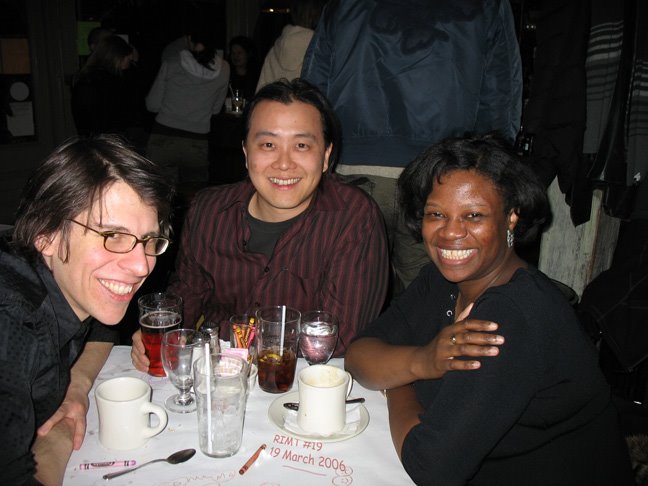
Here at the Ear Inn after show for a much needed drink. (L-R: Writer Sammy Buck, Composer Andrew Ingkavet, Writer Cheryl Davis - some of the participating artists in RIMT19 - photo by Composer Dan Acquisto -hear his work in the upcoming RIMT21 )

We survived and even prospered - the 19th Raw Impressions Music Theater event has ended. But wait there's more this weekend and next with whole new teams of composers, writers, performers and directors creating new 10 minute musicals.

As I said in my previous post, I find the act of creating fast and furious to be exhilirating, freeing and inspiring. Highly recommend it as a creator and an audience member.

Oh, and our theme was Grifters, Drifters and Hustlers - not that these fine folks are in anyway...not to besmirch their characters.

Thursday, March 16, 2006

Creating Fast and Furiously


This past Friday I went to a meeting with about 40-50 people – actors, directors,writers, composers, producers – and after hearing the actors sing a song each, we were split into teams, given a theme and told
"Go write a 10 minute musical. And it will be produced and performed the following weekend.
Oh and you have 48 hours for a first draft."

Well my team's show is going pretty amazingly well (there are 8 teams) and you're all invited to it this coming Sunday and Monday evening 7 and 9pm in New York City.

Check Raw Impressions for info/tickets. It will sell out. I'm in the event RIMT#19-Guitar-based music theater - "Grifters, Drifters and Hustlers."


And there's something about creating as quickly as possible. A teacher/mentor of mine says "Write Like Mad!" And I was like, why? It's only an exercise. "Well, you'll one day be in the situation where you have a string quartet to write/orchestrate in 24 hours. Get in the habit of writing as quickly as possible."

It's good advice. Most commercial jobs I've worked on in the last 5 years have been,
"We need it yesterday! Can you give us a broadcast-quality produced demo by the end of the day? And if we like it, you'll have time for revisions." (perhaps another 24 hours.)

There's a lot of talk about quick decision-making lately. The Boston Globe ran an interesting article summarizing the whole state of this recently Malcolm Gladwell (famous for "The Tipping Point") has a current best-seller "Blink" about how we make decisions in the blink of an eye and then spend hours, days, weeks and even months rationalizing, justifying to our conscious-left brain why it's the right decision.

I find that when you shut down the editor in your brain and just create as quickly as possible, you reach for intuitive, instinctual choices that really are at the core of your "true voice."

As the great teacher of composition, Nadia Boulanger once said, "Never ignore the obvious." and “Everything we know by heart enriches us and helps us find ourselves. If it should get in the way of finding ourselves, it is because we have no personality.”

Word!

Thursday, March 09, 2006

Jazz-based Film Scores


Otto Preminger's 1955 film, The Man With the Golden Arm is one of those works that has been at the convergence of my worlds as a Composer and a Visual Designer (worlds colliding!) I had never seen the film until last week though was thoroughly familiar with the opening credit sequence or white lines on black background and the unforgettable crooked arm logo design by Saul Bass. Bass is also known for his design of the shower scene in Psycho which Hitchcock handed completely over to him.
View opening credit sequence.

Elmer Bernstein's music is one of the first jazz-influenced scores and makes sense to the story. Frank Sinatra's drug addicted Frankie Machine, the man with the golden arm, so named for his golden touch as a card dealer for an illegal poker club is back from rehab and has learned to play the drums. He wants to change his life and join a big band.

Elia Kazan's 1951 film Streetcar Named Desire with score by Alex North may be the first score to use jazz. But the Man with the Golden Arm comes up again and again as such an influential film. The confluence of forces of being in the right place at the right time, the perfect graphic design, a big named star and of course the powerful and unforgettable motif in Bernstein's score. Bernstein often called himself Bernstein West to differentiate from the other Bernstein, the New York-based Leonard who also contributed some great film scores including "On The Waterfront" and of course, "West Side Story" based on the play for which he also wrote with Stephen Sondheim.
One of my favorite soundtracks of recent past is Michael Giacchino's for "The Incredibles" with Grammy award-winning big band arrangements by Gordon Goodwin.

Sunday, March 05, 2006

More evoking film tension through music


As we started to discuss evoking tension on screen in a previous post on Blood Simple, let's turn to another Coen brothers film which shared some of the same ironic black comedy.

It's a delicate thing to add music to a scene. This is a short clip of the first killing in Fargo. Less is more and the mounting tension is so delicately evoked with high strings/electonic textures. As the situation starts to build low horns/strings creep in. The decision to kill quickly moves to a fast crescendo of drum rolls, screaming brass and cymbal rolls among other things. Also note the stunned silence after the climax.

It's effective and well within the harmonic language of modern film scores. Fargo was made 9 years after the Coen brother's debut with Blood Simple in 1985. Obviously having a string of hits enabled them to have a larger budget and Carter Burwell's orchestral score reflects that. No cheesy synth sounds here. Carter is in the enviable position of being the "go-to" Composer for not only the prolific Coen's but also the gifted (and busy) director Spike Jonze.

Wednesday, March 01, 2006

Disney starts to transform

Some new changes are starting to appear at Disney now that the Pixar thing has happened. Composer-Songwriter Alan Menken (of Pocahontas, Little Mermaid fame) is signed to a non-exclusive multi-year, multi-picture deal. Perhaps the Pixar process of keeping it all in house is starting to spread in the new Disney. Also major animation directors are starting to return.

I grew up listening to and loving the work of the Sherman brothers with their amazing work in Jungle Book, Winnie the Pooh, the Aristocats, Chitty Chitty Bang Bang, Mary Poppins, the mega hit "It's a Small World" among many, many others...it's truly amazing how much great work they did.

Tuesday, February 21, 2006

Interview with Rachel Portman


Studio 360 did a piece on Film Composer Rachel Portman (Cider House Rules, Manchurian Candidate, Chocolat, Emma, Joy Luck Club) this past weekend. She just finished the score for Roman Polanski's Oliver Twist coming soon.

Sunday, February 19, 2006

12 Tone Music


Artwork by Doctor S.

While 12 tone music has never really taken off among the listening public, it became the academic approach to composition at the ivory towers. For film music, the 12 tone system can come in quite handy giving one a planned method for achieving a certain amount of dissonance. This is especially useful for tense, horrific, or macabre moments. It also can be used to evoke jazz as David Shire did in his beautiful score to the Joseph Sargent's 1974 "The Taking of Pelham, One, Two, Three," starring Walter Mathau. Take a listen to a moment from the film here.

Nice article in the Boston Globe on the father of 12 tone music, Arnold Schoenberg.
"Schoenberg was 18 years younger than Freud, who put names on recognizable emotional conditions no one had described openly before. What makes Schoenberg's music essential is that he precisely delineated recognizable and sometimes disquieting emotional states that music had not recorded before. Some of his work remains disturbing not because it is incoherent, shrill, and ear-splitting but because it unflinchingly faces difficult truths." - the Boston Globe.

Friday, February 17, 2006

Evoking Tension in Film


This is one of those emotions that is almost singlehandedly carried by the music in a film. Try watching any tense moment on film with the sound turned off and it's completely lost. I tried to watch the beginning of Monsters, Inc. with my 3 year old son recently. I had forgotten how scary the opening moments were - and my son has never seen anything scarier than Dora the Explorer or Maisy or Miffy. (Noggin is big in our house.) And as my son started to slink down into the couch, I reached for the volume to erase the scariness.

John Williams' 2 note motif for the shark in Jaws still brings back terror to many. Flicking through the channels the other night, I stumbled on a film noir moment and the soundtrack was just chilling.

The Coen brothers' first film Blood Simple, scored by Carter Burwell, is one of my personal favorites. In re-watching it this week, I noticed how cheesy the synth sounds used were. Most of the first scenes of tension used these synth patches which have been relegated to the discount bins now. The main theme of the film really holds up well with it's minimalist piano and moodiness. Then again, they made the entire film for $1.5 million with funds invested mostly from small business people and nobodies far, far away from Hollywood.

I also noticed how some of the main tense moments utilized diagetic music (see my previous post on Diagetic vs Non-Diagetic) as the score and it worked quite well.
Take a look at this short clip. In this final moment of the film (don't look if you haven't seen the film, you'll know too much)
Frances McDormand's character is being hunted and is desperately trying to save herself. The music in the moments before this seem to be coming from her Portugese neighbor's window echoing through the courtyard. The diagetic music then rushes up to the forefront building on the final moments. (M. Emmet Walsh is fabulous btw. Remember him in Blade Runner?)

Blood Simple won the Grand Jury Prize at the 1985 Sundance Film Festival

Monday, February 13, 2006

The Beautiful Country


This is a beautiful, yet heartwrenching story. Norwegian Director Hans Petter Moland has shined the light on some pretty horrific things that happen everyday to illegal immigrants. The story follows a half-Caucasian/half-Vietnamese young man from his home to his search for his real mother and then his father in the USA. The score by Zbigniew Preisner (Three Colors Red, and all of those great Polish films) is haunting and delicate. The early scenes in Vietnam felt a little trying too hard to capture Vietnamese exoticism, but as soon as we move in to the modern film harmonic language, Preisner's score is very effective.

Nick Nolte's performance is just spot on perfect.

What made it even more hard to watch was the fact that we used to live in Hong Kong and have seen the camps set up for the Vietnamese. Set in the most beautiful green hills in a remote area, the walls were 20 feet high blocking any view of anything except for the sky. My wife went to the camps to run some HIV workshops and the people were just so appreciative to have anyone from the outside actually thinking about their well-being. Some of those kids then took part in the summer school program (Summerbridge Hong Kong) she directed.

The magic of film has made us all feel the pain and suffering in a way like no other.

----
I went to Vietnam in 1993 to headline a concert on China Beach at an international surf competition. We stayed a night in Ho Chi Minh City and played an impromptu gig at a club/restaurant where we were eating dinner. There was a wedding going on and the bride and groom and all their guests gave us a standing ovation. Flying in, we saw hundreds of "crater lakes" which covered the country. We played a gig at the Da Nang city hall with amps that looked like were from pre-war Soviets. I lost my electronic tuner that night. There were hordes of very enthusiastic young Vietnamese men hanging around us everywhere. One night at a club where we were honored guests watching some great music, I expressed my admiration for the Vietnamese instrument called the dan bau. It's a single string wooden instrument that sits on a table and the tension of the string is changed with a flexible plastic or wooden "bow". The player, usually women, can express so much by also using harmonics created by touching the side of the hand to the string. The band we saw were fully amplified and the player, a man, was doing Jimi Hendrix plays the dan bau. Awesome! The next night, standing on the beach playing our concert, a man came up to us and said he had heard I was interested in the dan bau and had driven 40 miles with his. I bought it and have since not been able to get it to sound anything close to what I heard that night.
We drove motorcycle across the rice paddies on the mud walls that line them. Stopped and had a slow drip coffee and baguette - best in Asia. And those beautiful school uniforms, flowing white as the girls rode home for lunch on their bicycles...Vietnam was/is so magical. It truly is a beautiful country.

Wednesday, February 08, 2006

Junebug - silence as score


I saw the lovely movie Junebug (director Phil Morrison) last night. Wonderful film with great acting, direction, editing, writing. The music credit reads "original music by Yo La Tengo", the indie group. And there was a song of theirs in the opening credits and at the end credits and then maybe 2 other music cues, which actually sounded like something out of a stock library. And then...silence.

The story is of a Chicago art dealer (played by Embeth Davidtz) who goes to a little town to sign an outsider artist and meets her new in-laws. There are these great shots of the neighborhood in a semi-rural location somewhere outside Chicago. And they are shown in complete silence. There are several sequences using this silent "score" to convey the emptiness in the neighborhood, the house of where her husband grew up and the community.

In many indie films, I usually feel like the dramatic action could have used some underscoring. Or worse, the song choices used instead of an original score take too much attention away from the story.

Here, the silence was so loud. Stunning and effective. Sort of like a John Cage score...Silence by Yo La Tengo.

Thursday, February 02, 2006

Paperwork, Contracts, Licenses

To make sure you have the right to put music in your film whether you hire a Composer or license a work from a Publisher and record label, you need to have the right paperwork.

We talked about the 2 basics before: A Synchronization License (sometimes called a Sync License) and a Master Use License. The sync license, from the publisher, allows you to put it to your picture and the master use is from the record label or whomever owns the "master recordings."

Here's a good place to look at sample contracts.