Saturday, July 29, 2006

Woody Allen on the 2 types of Film


Woody Allen interviewed on PRI's Studio 360 with Kurt Anderson:

"Sometimes I think to myself that there are 2 types of films. There's the confrontational film that deals with life issues and existential issues and political issues. And there's the kind of film that is escapist. And I always debate with myself – which one makes the better contribution? You would think off the top of your head that the confrontational films are superior to the escapist films. But the truth of the matter is, the real philosophical issues of life, you know religious issues, issues of mortality and issues of human suffering are never resolved in any of these movies. Because you can't resovle them. So people just go and they commiserate masochistically and they come out of the theater moved in some way. Where with an escapist film, at least you give the audience a chance to get away from the horrors of reality for an hour and a half. It's like going into air conditioning or something and just sitting down and watching Fred Astaire dance for an hour and a half. You come out at least refreshed. And then you can go on with your life a little bit. And so I'm not sure that escapist films and comic films are not more of a help in the long run. Even though the temptation is to always to think and to want to do more substantive things."

Wednesday, July 26, 2006

Trust your Creative Team

This is a great post about advertising creative which applies equally well to this world of filmmaking.

When you hire your team - trust them to do the job you've hired them to do regardless of whether they are a DP, or an Editor, a Production Designer or a Composer. 1+1+1 really does equal 58,000,000!

snippet:
BART CLEVELAND: A creative team walks into the conference room with freshly mounted layouts underarm. They have worked untold hours to develop the ideas they now carefully share with others. Every detail has been examined and re-examined. There has been nothing left to chance. The work is superb. Their audience applauds with appreciation and admiration.

Then there is the “pause to reflect.”

A glimmer appears in one observer’s eye. Similar to telling a painter where he has missed a spot, the observer helps make a good idea better by adding that perfect little addition that causes good to become great. Then another glimmer appears in another observer’s eye. Well, I can’t go on because it’s just too gruesome.

Monday, July 24, 2006

Your True Voice


Every artist spends a lifetime searching, discovering, refining and rediscovering their "voice." Whether a painter, a novelist, a dancer, a singer or a composer. The artist, regardless of medium, expresses themselves in a certain way that after a few experiences of this artist's work, is readily recognizable. It's the artist's "filter" on the way they perceive. Things come through them and are twisted and shaped and come out as a "Picasso", a "Faulkner" or a "Beethoven."

Recently, I took part in a great film scoring workshop. A bunch of us have put our work online so you can really see how no Composer approaches the same scene the same way. Take a look/listen.

Friday, July 14, 2006

All my secrets revealed...


There's an interview with me posted today at music supervision central.

Thursday, July 13, 2006

Edit Ves Filmmaker's Festival, Frankfurt Germany


Just got the exciting news that I will be a featured presenter at the 9th annual Edit Ves Filmmaker's Festival in Frankfurt, Germany on September 25, 2006. The festival is unlike others in that it delves deep into the heart of process, approaches, theory on the art of visual storytelling and attracts professionals in the areas of film, television, commercials, gaming, new media and more.

I will be speaking and showing examples of our process at 300 Monks especially with regards as how we bridge the gap in communicating about emotions from visual to audio.

Previous festivals have included talented filmmakers such as Roland Emmerich, Michael Ballhaus, Dante Ferretti, Dennis Muren, Vilmos Zsigmond, Phil Tippett, Peter Greenaway, Marco Müller, Tom Rolf, Bill Plympton, Emir Kusturica and many more incredibly skilled storytellers.

The festival runs from the 24th to 26th of September. You can learn more here.

Sunday, July 09, 2006

A Filmmaker's Audio Team


Don't let these guys do your film sound!


There seems to be not a lot of information given filmmakers in school or even in books regarding who can help with the audio side of film.

Before we do this there needs to be distinction between location audio and post- audio. These are very different jobs and usually different people as the equipment, disposition and skills are completley different. Location audio guys will have a mobile recording setup (either 2 track or multi-track) which nowadays can be on miniDisc, tape, CD, DAT, DVD, Hard Drive or a swappable media such as CompactFlash, SmartDisk, MemorySticks or something similar. Some of these units can hook into the camera or a digital slate for true professional recording with reference points for the later tedious and laborious process of logging all the footage and audio and syncing it. Location audio specialists will also have a number of special mikes including shotguns, lavalier (hopefully wireless) and boom poles and windscreens. This stuff is not cheap. The blimp windscreens alone are around $500! An industry standard Sennheiser shotgun mic is over $1000. And then headphones and perhaps a mobile battery-powered mixer for multi-mic recordings.

For post-production audio, your team can include one or all of the following:
- Music Supervisor - person with a vast encyclopedic knowledge of music who can suggest/find songs for use in film and then arrange the licensing agreements for those songs. The licensing part may actually be more work than the actual creative part especially with well known songs. Can also be the person to hire the Composer.

- Music Editor - person who edits the music to conform with the picture. may also add a temp score to the rough cut for use by the Composer.

- Composer - person who will write the music for the film. This person, depending on the deal, may also be responsible for contracting the musicians, conducting and recording the score. The greatest Composers can lift up, unite and emotional bind a story as music speaks quickest to the heart, leading the eye.

- Music Producer - a vague term in film, this person can be in charge of the music for the production. Can also be another name for the Music Supervisor or the person who brings all music elements into the production. For example, T. Bone Burnett was the Music Producer for the film "Walk The Line." His job included finding the songs they would sing, teaching Reese Witherspoon and Joaquin Phoenix to sing believably, arranging the songs, contracting the musicians and booking a studio and supervising the production of the final recordings.

- Sound Designer - These people are unique in their ability to create and recreate sounds that create hyper-realism on screen. They often will mix in unexpected sounds to beef up the results. For example, in "Fight Club" the sounds of the punches were layers and layers of sounds of meat being punched, kicked and beat. It was so powerful, the director David Fincher asked for a version without the extra violent sounds to pass the review board for an R rating instead of an NC-17.

- Mix Engineer - This person is the one to bring all the final audio elements together into a cohesive experience. These disparate elements can be dialog, sound effects, music in final mixes, or music in stems, voiceovers and source sounds. They can do separate mixes for cinema, television, web, promos, and these can be in a combination of stereo or surround sound.

Wednesday, June 14, 2006

One Second Radio Ads - Audio Branding In A Blink

From AdAge:
BACKGROUND: Clear Channel, the country's largest operator of radio stations, is discussing the idea of one-second radio spots with marketers and media buyers. Called "Blinks," the new format is being promoted as something that could be used between music tracks by, say, McDonald's to play part of its "I'm lovin' it" jingle or Intel to play its chime or NBC for its bells between music tracks. Clear Channel VP-Creative Jim Cook says the one-second format is part of an effort "to find new uses of radio for advertisers who are continually asking us to demonstrate that our medium can successfully extend brands, can successfully reach the consumer with touchpoints that are new and surprising." Critics suggest the format is likely to fit a very small number of advertisers and is too restrictive for meaningful creative. What do you think?

I think it's a natural evolution. Everything has been moving to smaller, faster, cheaper, better. The human mind/ear can discern and recognize melodic fragments, textures, harmonies in a millisecond. And as the article suggest, it's probably best suited for marketers who have already had media exposure to their audio mnemonics such as NBC or Intel or McDonalds.

I'd love to work on one of these if anyone wants to try it out. I've done some short audio mnenonics for HP in the past that were never sold through. Anyone?

Tuesday, June 06, 2006

Keeping Your Film's Action Moving With Music


A great thing to keep in mind whether you are using a song or score with your film scene is to be mindful of closing cadences. A cadence is a musical term to describe an ending point. In classical era music you often hear a series of chords that set up the final resounding last chord. Pop songs also usually have clearly defined endings or fadeouts which signify the end.

If you want to keep propelling the dramatic action forward, edit your music so that it never ends on a finality. It stops the dramatic action and subconsciously closes the curtain. This may be useful for the end of Act 1 in your screenplay, and yet it also may stop the action too early.

Martin Scorsese is currently working on a film called "The Departed", (a remake of a 2002 Hong Kong film entitled Infernal Affairs) and Howard Shore is scoring. According to Tim Starnes (one of Shore's right hand men) Scorsese is very much attuned to the "curtain calls" in the music. Whether it's song or score, he often edits the piece to start after the beginning and end in the middle.

If you are working with a Composer, you can bring this up in conversation early in the process.

One way Composers can avoid the "dramatic finality" is to avoid the use of the tonic (the root note) in the bass. As orchestrator Deniz Hughes likes to say, "putting the tonic in the bass is the dramatic equivalent of sitting in a chair. You're not going anywhere. You're static."

Monday, June 05, 2006

Audio Branding the AARP


Today's New York Times has a great article on audio branding with the AARP as the client.

Thursday, June 01, 2006

Bourne Again


So the culmination of my 2 weeks at the ASCAP/NYU Film Scoring Workshop in memory of Buddy Baker was to rescore the final scene from the Bourne Identity.

We spent a day sketching, another to orchestrate and then checked it by conducting a piano reduction with a rehearsal pianist

(conducting the pianist)


and then the big day with an outstanding 23 piece orchestra. 3 takes and there we were.

Here's the clip without any music.

Here it is with my take on the score.

(A portion of an early sketch - it changed continuously until 3am the night before the recording!)

And I don't remember what the original by John Powell sounded like. What was really interesting was seeing other Composers versions of the same scene (we had a choice of 4 scenes.) No one sounded alike and everyone had their own voice/thumbprint.

A great exercise and highly recommended for Composers and anyone interested in Film Music. You can audit the program as well which may be useful for Producers/Directors wanting to know how the whole process works - and having a pick of 18 amazing composers to work with in the same room!

Wednesday, May 31, 2006

Creating Something From Nothing


Just spent an exhilirating, exhausting and truly inspiring 2 weeks in the Buddy Baker Film Scoring Workshop co-sponsored by NYU and ASCAP. In it's sixth year and now in memoriam to Buddy as he passed away a few summers ago.
Buddy was one of the long-time Disney composers (something like 28 years!). Those studio golden days seem to be over - especially in terms of music departments. Even Pixar, the closest thing to the studio setup that Walt had, doesn't have composers on staff.

In the old days of Disney, animators and composers would talk and meet periodically and then work parallel paths. Animators had a time sheet and script/storyboard which they would work from and composers would take that information and create their cues. The picture and music would get married up only towards the very end. It really is creating something from nothing. Yes there is a story and that's what holds the two together. Too often in today's pressurized, commercialized productions the picture is given all the attention and the music is literally slapped on at the end. Now I have no doubt that great music supervisors can find music that fits your picture and adds something you never could have imagined. On the other hand, films like Lord of the Rings or Star Wars...I can't imagine them having such long-lasting influence and impact with a licensed score. Yes there are times you NEED a song from the popular culture zeitgeist. Scorsese does it all the time. And now he also uses Howard Shore for scoring those other scenes that need underscore. Or you can hire someone to write songs specific to the film - this seems to be out of fashion nowadays.

I call it the Rise of the Editor culture.
When hiphop started to take the film editors approach to assemblage using "found footage", filmmakers also started to take the same approach towards their music soundtracks. And with anyone who grew up in the age of MTV, fast cuts and cutting to music is the norm.

I'll share more of the workshop in the next few days.

Sunday, May 28, 2006

Jazz Renaissance in Brooklyn


An excellent article in the NY Times on the boom of jazz venues right here in our 'hood.

Tuesday, May 16, 2006

Film Composing: Where is the Love?

For many first time directors, there is a huge underestimation of the amount of work involved on the part of Composers and I suspect Editors. Though editors usually are sitting with the director for perhaps weeks or months at a time, Composers are given a brief conversation and then left to their own devices for the most part. 4 to 6 to 8 weeks later the score is delivered and if there is not massively clear, constant and open communication between the two, disasters can happen. With so much of the subtext being communicated via music score (depending on the film) it's astonishing more thought/training is given this area.

At the recent Sundance at BAM brunch, I was impressed by the amount of support the Institute provides from the ground up and in so many more areas than I knew: film, theater, film music, screenwriter's labs, directors labs. And the cross-communication between the different labs sounds impressive as well. I know I'd like to go - I'll have to wait until next year as the deadline is April 1. It's interesting to note the Sundance Film Festival does NOT have a category for Best Music Score.

On the other hand, IFP, the huge NY-based indie filmmakers network aims to support filmmakers similarly. The results are a bit less impressive, especially as regards film music. At a recent IFP Market panel on film music, the majority of the conversation was on licensing tracks from your favorite band. There was so little advice on where directors can meet composers. It's as if they all were saying you can find a great indie band that has a film composer in it.

And then, there's the Independent Spirit Awards - where's the category for best music score?

Thursday, May 11, 2006

Short Film - K7


This is another short that really got my attention at Tribeca. It has that great Kafka-esque quality of not knowing why and how things are happening at the same time being hysterically funny. It's also amazing as you realize how entertaining it can be with little more than an office as a shoot location. Great writing and wonderful performances. Directed by Christopher Leone.
Inspiring.

Here's a clip.

Wednesday, May 10, 2006

Short Film - Lure


Saw this great short at the Tribeca Film Festival by Writer/Director Mark Mollenkamp. Very cool and current, Lure has a pretty great surprise ending. In speaking to the director at the bar, he mentioned that he got a meeting with the Weinstein Company out of this. Not bad for an 11 minute short.

You can see a preview.

Friday, May 05, 2006

The Groomsmen


Saw the Groomsmen the other day at Tribeca Film Fest. It's the latest film by writer/director/actor Edward Burns. While I always found Edward Burns' characters to be repulsively smug, I must say I enjoyed this film. Very well written and performances from John Leguizamo (viva Colombia!) and Jay Mohr (who almost steals the show). The inciting incident is the upcoming wedding of the Burns character to his pregnant girlfriend and the week hanging out with his groomsmen before the big day. They're all kids at 35 and trying to grow up.

The setting is in Long Island - which is where I grew up. It really hits it on the nose - I was cringing with the puffy hairdos, the "strong island" references, the horrible 80's rock songs and the accent (Ya wanna get sumthin ta eet?). I should have hated this film - but it's a great story and well done.

I'll pass on the soundtrack though. What was it with the 80's?

Thursday, May 04, 2006

What would Jesus Direct?


That was the panel I saw the other day at the Tribeca Film Festival. Due to the recent success of Mel Gibson's Passion of the Christ, everyone's looking for the next religious hit.

With Cuba Gooding Jr., Jonathan Bock(Grace Hill), Ralph Winter(20th century Fox, Michael Flaherty (co-founder Walden Media and moderated by a woman from PBS, the panel talked about the sudden realization by Hollywood of the Christian market. Flaherty mentioned that a recent survey had 40% of Americans in church on Sunday - duh! What a huge mega market. Walden Media had a huge hit with Chronicles of Narnia which as one audience member said "I'm Jewish and I read that book as a kid and loved it. I didn't think about is this a Christian book or not - it's a great story."

And as the panel went on - the basic overall message is: is it a good story? Will it captivate people no matter what their faith?
Poor Marty Scorsese with his Last Temptation of Christ which brings up many of the same issues that the coming DaVinci Code does. Too early? Well actually most people found the film too boring.

I still love the soundtrack by Peter Gabriel - it's even better than the film.

And in related news...the film I scored last year Mrs. Worthington's Party is now garnering some interest at a certain major studio. As it deals with priests and the Catholic Church and Christmas, we hope to see it on the big screens just as the first snow falls. I may be in Bulgaria in the next few months recording new bits of score. Stay tuned.

Thursday, April 27, 2006

Secrets of the Code


The 5th annual Tribeca Film Fest is in full swing. It's my first time going and it's nice to see how intimate it is.

Saw an interesting preview of a work in progress last night called Secrets of the Code based on a book of the same title. It's another of the many projects that have been spawned by Dan Brown's mega blockbuster book "The Da Vinci Code". There's an entire industry built out of that book with other books debunking or debating issues brought up in it, documentaries (at least 10 out there) and even travel tours to Paris and places visited in the book.

And...on May 19th, the Hollywood film version by Ron Howard and starring Tom Hanks is unleashed to something like 50 countries simulataneously. Many predict it will be the biggest grossing film of all time. And Hans Zimmer is Herr Maestro.

Tuesday, April 25, 2006

The Spy Genre of Music - All things Secret Agent


It's been a long time since I last posted. Sorry for the break - just needed to take care of a hundred things including a score for a short animated film for Pfizer's Listerine brand. Yes - it's a mini DVD that's going to be included on a millions of product packages for Agent Cool Blue. With a name like that, of course it's going to be an animated character super-hero.

And I got to play in a great area of music - the 50/60's tv spy theme genre. Peter Gunn, Get Smart, Pink Panther, James Bond, Secret Agent Man, Batman, the Man with the Golden Arm and all those great jazzy classics. And after carefully researching my references - which I do on every project - it was revealed to me the secret black knowledge of the 1950's/60's movie/television composer.

There's a very specific scale that everyone in this genre used. It's like each theme is an inversion of the other. Anyway, you can hear a sneak peek at my theme here.

Kapow! Blam! Zowie! Zoinks!

Wednesday, March 22, 2006

Grifters, Drifters and Hustlers


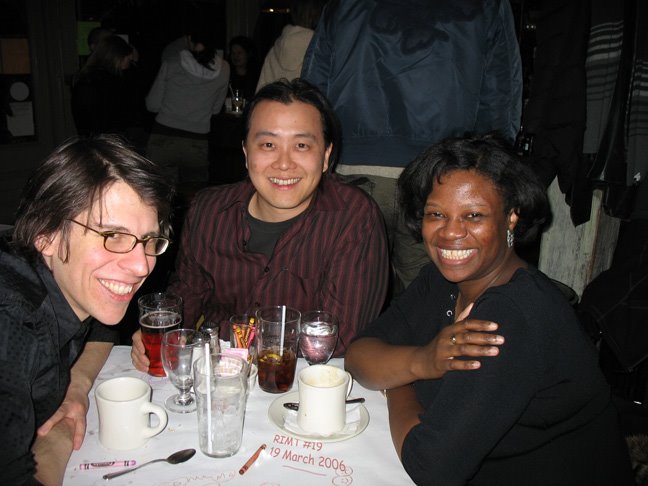
Here at the Ear Inn after show for a much needed drink. (L-R: Writer Sammy Buck, Composer Andrew Ingkavet, Writer Cheryl Davis - some of the participating artists in RIMT19 - photo by Composer Dan Acquisto -hear his work in the upcoming RIMT21 )

We survived and even prospered - the 19th Raw Impressions Music Theater event has ended. But wait there's more this weekend and next with whole new teams of composers, writers, performers and directors creating new 10 minute musicals.

As I said in my previous post, I find the act of creating fast and furious to be exhilirating, freeing and inspiring. Highly recommend it as a creator and an audience member.

Oh, and our theme was Grifters, Drifters and Hustlers - not that these fine folks are in anyway...not to besmirch their characters.